

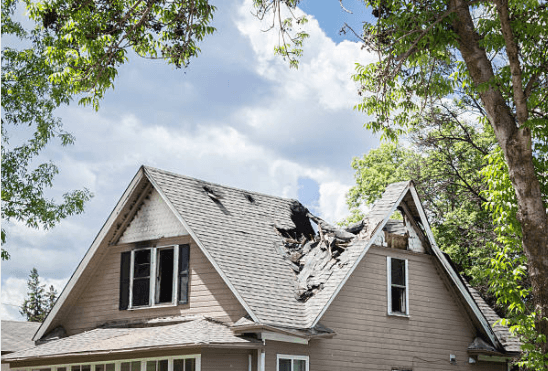
If a storm, fire, or flood damaged your home and your insurance did not cover all of it, there is a second question worth asking after the claim: can you deduct what you were left holding?
Sometimes yes. The rule is called the personal casualty loss deduction, and it is narrower than most homeowners expect — but it also just got broader for the first time in years. This page explains who qualifies, how the math works, and the one part almost nobody warns you about: your insurance settlement directly reduces the deduction.
What a casualty loss actually is
In tax terms, a casualty loss is damage to your property from a sudden, unexpected event — a storm, a fire, a flood. Sudden is the operative word. Damage that developed slowly, like a leak that seeped for months or ordinary wear and tear, is generally not a casualty loss.
This page covers personal-use property: your home, your household contents, your personal vehicle. Business and rental property follow different rules, and if that is your situation you need a tax professional rather than a web page.
The big limitation — and what changed in 2026
Here is the gate that catches most people.
For losses from 2018 through 2025, the Tax Cuts and Jobs Act restricted the personal casualty loss deduction to losses caused by a federally declared disaster. Damage from an event that never got a federal declaration generally was not deductible at all, no matter how expensive it was. That is the rule that applied to the 2025 return filed in April 2026.
The One Big Beautiful Bill Act (P.L. 119-21) then did two things. It made that federally-declared-disaster requirement permanent — so it is not expiring. But effective January 1, 2026, it also expanded eligible losses to include certain state-declared disasters, provided the other requirements of the tax code are met.
That matters. It means some losses that would not have qualified a year ago may qualify on the 2026 return you file next year. If your damage came from an event your governor declared but the president did not, that is now worth asking a tax professional about instead of assuming no.
There is also a narrow exception that has always existed: if you have personal casualty gains — because insurance proceeds exceeded your tax basis in the damaged property — you can deduct personal casualty losses that were not from a declared disaster, up to the amount of those gains.
You have to itemize — and that stops a lot of people
Even a qualifying loss only helps if you itemize deductions on Schedule A. Since 2018 far fewer households do, because the standard deduction is large and got larger.
For 2026, the standard deduction is $16,100 for single filers, $24,150 for heads of household, and $32,200 for married couples filing jointly.
So the practical test is not just "did I have a qualifying loss." It is whether your casualty loss plus your other itemized deductions add up to more than your standard deduction. For many homeowners with moderate damage, they do not — and the honest answer is that the deduction will not change your tax bill.
How the deduction is calculated
Four steps, in order.
1. Start with the smaller of two numbers
Your loss is the lesser of your adjusted basis in the property (generally what you paid, adjusted for improvements) or the decline in its fair market value from the event. Not the cost to rebuild. Not what the house is worth. The lesser of those two figures.
2. Subtract your insurance
Your loss is reduced by any insurance proceeds you received. If insurance covered the entire loss, there is no casualty loss deduction to claim.
3. Subtract $100
A $100 floor applies per casualty event.
4. Subtract 10% of your AGI
Only the portion of the remaining loss that exceeds 10% of your adjusted gross income is deductible.
That last step is why modest losses usually produce nothing. Ten percent of income is a high bar to clear before the first dollar becomes deductible.
Qualified disaster losses are treated better. For losses that meet the definition of a qualified disaster loss, the 10% of AGI reduction does not apply and the $100 floor is increased to $500 instead. Whether your specific event qualifies is a determination for a tax professional — the category is defined by legislation and does not cover every declared disaster.
The part nobody warns you about — your settlement changes your taxes
Read step 2 again: your deduction is reduced by insurance proceeds.
That means your insurance settlement and your tax deduction move in opposite directions. A larger settlement means a smaller deduction. A smaller settlement means a larger potential deduction.
Homeowners sometimes hear that and conclude a low settlement is not so bad, because taxes will make up the difference. It does not work that way, and this is the most important sentence on this page: a deduction only reduces the tax on a portion of the loss — it never reimburses the loss. After the $100 (or $500) floor, the 10% of AGI reduction, and the itemizing requirement, most homeowners recover a fraction of an underpaid claim through the deduction, if anything at all.
The settlement is the money. The deduction is, at best, a partial cushion on what the settlement failed to cover. If your claim was underpaid, the fix is the claim — not the tax return.
If your claim was denied or underpaid
This is where the two issues meet. A denial or a lowball offer leaves you with unreimbursed loss, which is exactly what the casualty loss deduction is measured against — and exactly what UPA exists to reduce.
An insurance company's denial is its position, not a final ruling. So is its estimate. Both are built from an inspection and a file, and both can be challenged with better documentation. UPA independently inspects the damage, builds the full scope of loss, applies the coverages in your actual policy, and re-presents the claim.
UPA is a 501(c)(3) non-profit public adjusting firm licensed to serve policyholders in the states and territories listed on our Find a Public Adjuster in Your State page. We never take a penny out of a property or business owner's pocket — our fee is covered by the overhead and profit built into the insurance settlement itself.
Form 4684 and what you will need
Personal casualty and theft losses are reported on Form 4684, Casualties and Thefts, and the deductible amount carries to Schedule A. The IRS also publishes Publication 584, a casualty/disaster/theft loss workbook designed to help you inventory what was damaged room by room.
Practically, your tax preparer will want:
- Documentation of what the property was worth before and after — which is why photographs taken early matter for your taxes and not just your claim
- Your purchase records and records of improvements, to establish adjusted basis
- Your insurance settlement documentation, including what was paid and what was denied
- Receipts for repairs and for emergency work
- The disaster declaration reference for your event
If you have been keeping a claim file, you already have most of this — UPA's claim documentation forms can help you organize what is left.
One timing option worth knowing about
If your loss occurred in a federally declared disaster area, you may be able to elect to deduct the loss in the tax year immediately before the year the loss happened — by amending the prior year's return rather than waiting.
The reason people do this is speed: it can put a refund in hand months earlier, which matters when you are paying for repairs. It is also a genuine election with deadlines and tradeoffs, and choosing the wrong year can cost you money. Ask a tax professional to run it both ways.
A separate change to know if you were in a wildfire
One relief provision has ended. The federal income tax exclusion for qualified wildfire relief payments applied to payments received from 2019 through 2025. Payments received in 2026 or later are taxable, even when the underlying wildfire happened during an eligible year.
If you are receiving wildfire-related payments now, do not assume last year's treatment carries over. That is a conversation for your tax advisor before you file.
The honest summary
The casualty loss deduction is real, and the 2026 expansion to state-declared disasters makes it relevant to more homeowners than it has been in years. It is also narrow: you need a qualifying declared disaster, you need to itemize, and you need unreimbursed loss large enough to clear the floors.
It is worth asking your tax professional about. It is not a substitute for a properly paid claim.
If your claim was denied, underpaid, or is still open and going nowhere, that is the part we can actually fix. Call 1-855-944-3473 — the review costs nothing.